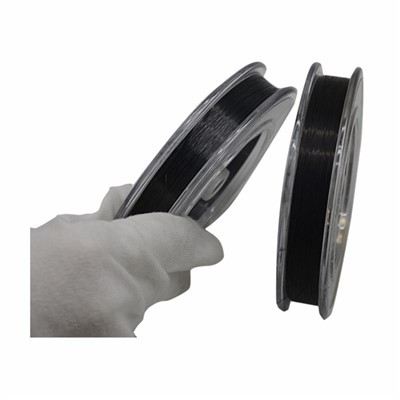
Hey there! As a supplier of Fine Tungsten Foil, I've got a ton of knowledge about this amazing material and how it stacks up against other metal foils. So, let's dive right in and explore the ins and outs of fine tungsten foil compared to its counterparts.
Physical Properties
First off, let's talk about the physical properties. Tungsten is known for its incredibly high melting point, which is around 3422°C (6192°F). That's way higher than most other metals. For example, aluminum has a melting point of about 660°C (1220°F), and copper melts at around 1085°C (1985°F). This high melting point makes fine tungsten foil ideal for applications where extreme heat is involved, like in high - temperature furnaces or aerospace components.
Another key physical property is density. Tungsten is a very dense metal, with a density of about 19.25 g/cm³. In contrast, aluminum has a density of 2.7 g/cm³, and copper has a density of 8.96 g/cm³. This high density gives tungsten foil a unique set of advantages. It can be used in applications where weight is a factor but also where a high - mass component is needed, such as in radiation shielding.
Mechanical Properties
When it comes to mechanical properties, fine tungsten foil is pretty tough. It has high tensile strength, which means it can withstand a lot of pulling force without breaking. This makes it suitable for use in situations where the foil might be under stress, like in electrical contacts or springs.
However, tungsten is also quite brittle compared to some other metals. For instance, copper is very ductile and can be easily bent and shaped without cracking. Tungsten foil requires more careful handling during fabrication to avoid cracking or breaking. But with the right techniques, we can still use it to create complex shapes and structures.
Chemical Properties
Tungsten is highly resistant to corrosion. It doesn't react easily with most acids and alkalis at room temperature. This is a huge advantage over metals like iron, which rusts when exposed to moisture and oxygen. In chemical processing plants, fine tungsten foil can be used in environments where other metals would quickly corrode, ensuring a longer lifespan for the equipment.
On the other hand, tungsten can react with oxygen at high temperatures, forming tungsten oxide. So, in high - temperature applications where oxygen is present, proper precautions need to be taken to prevent oxidation.
Electrical Properties
Fine tungsten foil has excellent electrical conductivity. While it's not as conductive as copper, which is one of the best conductors among metals, it still has good enough conductivity for many electrical applications. Its high melting point also means that it can handle high electrical currents without melting, making it suitable for use in high - power electrical devices.
Comparison with Other Metal Foils
Let's compare fine tungsten foil with some other common metal foils in more detail.
Aluminum Foil
Aluminum foil is very lightweight, inexpensive, and easy to work with. It's widely used in packaging, cooking, and electrical insulation. However, its low melting point and relatively low strength compared to tungsten make it unsuitable for high - temperature and high - stress applications. Fine tungsten foil, on the other hand, can handle extreme heat and stress, but it's more expensive and harder to work with.
Copper Foil
Copper foil is known for its excellent electrical conductivity and ductility. It's commonly used in printed circuit boards and electrical wiring. While tungsten foil also has good electrical conductivity, copper is better in this regard. But copper is more prone to corrosion than tungsten, especially in certain chemical environments. So, depending on the application, either copper or tungsten foil might be the better choice.
Stainless Steel Foil
Stainless steel foil is corrosion - resistant and has good mechanical properties. It's used in a variety of industries, from food processing to automotive. However, it doesn't have the high melting point or the unique electrical properties of tungsten foil. In high - temperature or high - electrical - current applications, tungsten foil would be a better option.
Applications of Fine Tungsten Foil
Fine tungsten foil has a wide range of applications. In the electronics industry, it can be used in semiconductors, as a heating element in vacuum tubes, or in the manufacture of electrical contacts. Its high melting point and good electrical conductivity make it ideal for these applications.
In the aerospace industry, tungsten foil can be used in components that need to withstand high temperatures, such as in rocket engines or heat shields. Its high density also makes it useful for counterweights and vibration dampers.
In the medical field, Fine Tungsten Foil can be used in radiation shielding due to its high density and radiation - absorbing properties.
Our Fine Tungsten Foil
As a supplier of fine tungsten foil, we offer high - quality products that meet the strictest industry standards. Our foil is available in various thicknesses and sizes to suit different applications. We use advanced manufacturing techniques to ensure the consistency and quality of our products.
We also offer Pure Tungsten Sheet and Tungsten Pipe for customers who have different needs. Whether you're looking for a small quantity for research purposes or a large - scale order for industrial production, we can provide the right solution for you.
Why Choose Us
We have a team of experts who are knowledgeable about tungsten and its applications. We can provide technical support and advice to help you choose the right product for your specific needs. Our customer service is top - notch, and we're committed to ensuring your satisfaction.
If you're interested in purchasing fine tungsten foil or any of our other tungsten products, don't hesitate to get in touch with us. We're here to answer your questions and help you with your procurement process. Whether you're a small business or a large corporation, we can work with you to meet your requirements.
References
- "Materials Science and Engineering: An Introduction" by William D. Callister Jr. and David G. Rethwisch
- "Handbook of Tungsten: Properties, Chemistry, Technology of the Element, Alloys, and Chemical Compounds" by Lothar E. Toth
So, if you're in the market for high - quality fine tungsten foil or other tungsten products, reach out to us. We're ready to start a great business relationship with you!